
⚠️ Big Island Safety Notice
The Big Island’s environment can change rapidly — ocean conditions, lava flows, weather, and trails may become dangerous without warning. These Guides are for educational purposes only and do not replace real-time assessments, posted warnings, or professional guidance. Always check current conditions before entering the water, hiking, or exploring, and do not proceed if conditions appear unsafe — even if a location is described as “safer.”
Table of Contents
A common question visitors ask on the Big Island is deceptively simple:
“Can I see dolphins or whales on the Big Island without booking a tour?”
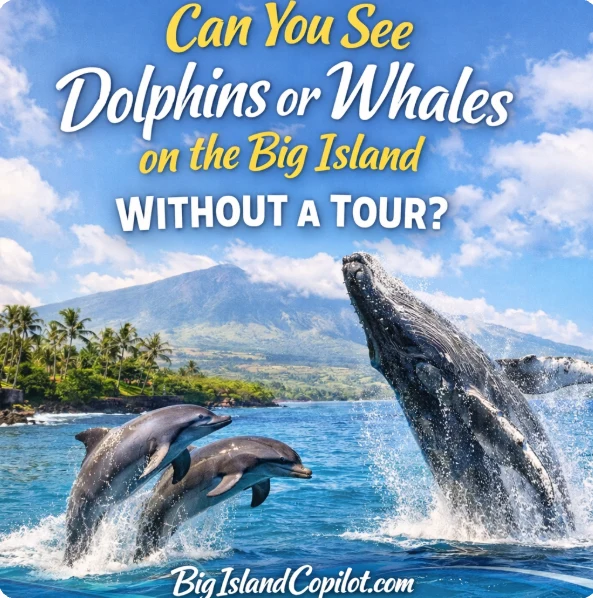
The short answer is yes — absolutely.
The longer answer is yes, but only if you understand what’s legal, what’s ethical, and how ocean conditions and wildlife laws actually work in Hawaiʻi.
Unlike many destinations, the Big Island offers real opportunities to observe marine mammals from shore or on your own. But Hawaiʻi also has some of the strictest wildlife protection laws in the United States, and many visitors accidentally cross legal lines without realizing it. This guide breaks it all down clearly.
Yes, You Can See Dolphins or Whales Without a Tour
You do not need to book a boat tour to see dolphins or whales on the Big Island.
In fact:
- Humpback whales are commonly visible from shore during whale season
- Spinner dolphins are frequently seen near the coast, especially in the mornings
- Turtles, manta rays, and other marine life are also regularly visible without tours
What matters most is timing, location, and behavior — not a ticket.
Whale Watching Without a Tour (Totally Legal)
When Whales Are Here
Humpback whales migrate to Hawaiʻi each winter.
Typical season:
- December through April
- Peak sightings: January–March
During this time, whales can often be seen:
- Breaching offshore
- Slapping tails or fins
- Traveling along the coastline
All from land.
Watching From Shore
Shore-based whale watching is:
- 100% legal
- Encouraged
- Often safer and calmer than boats on rough days
Many visitors see whales:
- From coastal overlooks
- From lava cliffs
- Even from beaches on calm days
Binoculars help, but they aren’t required.
Dolphins Are Different — and More Restricted
This is where most confusion (and accidental law-breaking) happens.
Spinner Dolphins Are Protected
Hawaiʻi’s spinner dolphins are highly protected because they:
- Feed offshore at night
- Rest in shallow bays during the day
Disturbing them during rest causes real harm.
Because of this, Hawaiʻi enforces strict rules About dolphin interactions.
What’s Legal With Dolphins
You may:
- Observe dolphins from shore
- Watch dolphins from a boat at a legal distance
- See dolphins while snorkeling if they pass by naturally
You may not:
- Swim toward dolphins
- Chase or follow them
- Block their path
- Surround them with people or boats
- Touch or attempt to interact
Even if dolphins approach you, you are required to:
- Stay passive
- Let them pass
- Avoid pursuit or engagement
Intent matters — and enforcement looks at behavior, not excuses.
The Dolphin Distance Law (Important)
Under federal and state law:
- You must stay at least 50 yards (150 feet) away from dolphins
- This applies on land, in water, and on boats
Violations can result in:
- Heavy fines
- Citations
- Federal enforcement action
This law applies even if you’re not on a tour.
“But I See People Swimming With Dolphins All the Time”
Yes — and many of those people are breaking the law.
Some reasons it still happens:
- Enforcement isn’t visible every day
- Social media spreads outdated or illegal behavior
- Visitors follow others without knowing the rules
But enforcement does happen, and fines can be severe.
More importantly:
Disturbing resting dolphins contributes to stress, injury, and long-term population harm.
Whales: What’s Legal and What’s Not
Whales are also protected, but the rules differ slightly.
Legal Whale Viewing
You may:
- Watch whales from shore at any distance
- Observe from boats if you remain 100 yards away
- Take photos and videos
Illegal Whale Behavior
You may not:
- Approach whales intentionally
- Position yourself in their path
- Follow or chase whales
- Swim with whales
Even accidentally drifting too close can become a violation if not corrected immediately.
Why Tours Exist (And When They’re Worth It)
Tours don’t give you permission to break laws — but good ones do offer:
- Experienced captains who know how to keep legal distance
- Spotters who identify behavior and movement
- Education about marine life
Tours are most valuable when:
- Conditions are calm
- You want close (but legal) views
- You’re unsure how to judge distance offshore
Tours are less valuable on rough days, when:
- Visibility is poor
- Wildlife stays deep
- The experience becomes uncomfortable or shortened
Shore Viewing Is Often Better Than Tours
Many locals prefer shore-based viewing because:
- No seasickness
- No crowds
- No pressure to “make something happen”
On calm mornings, whales and dolphins often pass naturally along the coast — especially near deep water drop-offs.
Shore viewing also guarantees you’re not:
- Accidentally pursuing animals
- Pressured by a group dynamic
- Paying for conditions you can’t control
Ocean Conditions Matter Here Too
Just like tours, wildlife visibility depends heavily on:
- Wind
- Swell
- Surface chop
- Visibility
Calm mornings are best.
Strong trade winds and chop make spotting difficult — whether you’re on land or at sea.
If conditions are poor, no tour can fix that.
Ethical Wildlife Viewing: The Big Picture
Legal doesn’t always mean ethical.
Responsible wildlife viewing means:
- Keeping distance even when animals approach
- Not sharing illegal behavior on social media
- Educating others gently when possible
Hawaiʻi’s marine life isn’t entertainment — it’s part of a fragile ecosystem that locals live alongside year-round.
Common Myths (Quickly Debunked)
“It’s legal if dolphins approach me.”
→ Only if you remain passive and do not engage.
“Tours are allowed to swim with dolphins.”
→ No. No one is exempt from the law.
“Everyone does it, so it must be fine.”
→ False — and enforcement does occur.
“Whales are far offshore.”
→ Not always. Many are visible from land.
Bottom Line
Yes — you can absolutely see dolphins or whales on the Big Island without a tour.
But:
- Distance matters
- Intent matters
- Behavior matters
- Ocean conditions matter
The best wildlife encounters here often happen when you:
- Stay patient
- Stay respectful
- Let the animals lead
If you remember one thing:
Seeing marine life on the Big Island isn’t about getting closer — it’s about knowing when to stay back.
That’s how you keep it legal, ethical, and unforgettable.
Best Places to Spot Dolphins & Whales From Shore on the Big Island (With Map Links)
You don’t need a boat to see marine life on the Big Island.
In fact, some of the best dolphin and whale sightings happen from shore, if you know where to look — and when.
Below are proven shore-based viewing spots, why they work, what you can realistically see, and direct map links so you can navigate without guessing.
How to Use This Guide (Quickly)
Before heading out:
- Go early morning whenever possible
- Check wind and swell (calm = better spotting)
- Bring binoculars if you have them
- Stay legal — observe, don’t pursue
Deep water close to shore is the secret sauce.
🌊 KONA SIDE (West Side)
Best for: Dolphins, whales (seasonal), calmer mornings
1. Kealakekua Bay (Captain Cook Area)
📍 Map: https://maps.google.com/?q=Kealakekua+Bay+Hawaii
Why it works:
- Deep water close to shore
- Sheltered from trade winds
- Natural travel corridor for dolphins
What you might see:
- Spinner dolphins (usually offshore or passing through)
- Humpback whales (winter months)
- Occasional manta rays
Best time:
- Early morning
- Calm days only
⚠️ Important: Dolphins here are protected. Viewing from shore is legal. Swimming toward them is not.
2. Puʻuhonua o Hōnaunau (Two Step – From Shore Only)
📍 Map: https://maps.google.com/?q=Puuhonua+O+Honaunau+National+Historical+Park
Why it works:
- Lava shelf overlooks deep water
- Frequent offshore dolphin movement
- Clear sightlines without needing to enter the water
What you might see:
- Dolphins offshore
- Whales breaching during season
- Turtles nearshore
Best time:
- Morning
- Incoming tide
📌 Tip: You don’t need to snorkel. The lava shelf itself is an excellent viewing platform.
3. Makalawena / Mahaiʻula Area (Viewpoints Along the Coast)
📍 Map: https://maps.google.com/?q=Makalawena+Beach+Hawaii
Why it works:
- Open coastline
- Deep offshore water
- Less development = quieter viewing
What you might see:
- Whale spouts and breaches
- Dolphins traveling offshore
Best time:
- Clear mornings
- Light wind days
🌧️ HILO SIDE (East Side)
Best for: Seasonal whales, dramatic viewing after storms
Not as calm, but still rewarding on the right day.
4. Richardson Ocean Park (Upper Lookouts)
📍 Map: https://maps.google.com/?q=Richardson+Ocean+Park+Hilo
Why it works:
- Elevated lava points
- Open sightlines
- Whales pass offshore during season
What you might see:
- Humpback whales
- Turtle activity
- Occasional dolphin pods farther out
Best time:
- Calm days only
- Morning before winds build
5. Honoliʻi Bluffs / Scenic Pullouts
📍 Map: https://maps.google.com/?q=Honolii+Beach+Park
Why it works:
- High vantage points
- Deep water offshore
- Good for spotting spouts
What you might see:
- Whales during winter months
⚠️ Note: This is a viewing spot, not a swimming area for marine mammal encounters.
🌋 SOUTH POINT / KAʻŪ
Best for: Whales, raw coastline, fewer people
6. South Point (Ka Lae) Lookouts
📍 Map: https://maps.google.com/?q=South+Point+Ka+Lae+Hawaii
Why it works:
- One of the deepest drop-offs in Hawaiʻi
- Whales frequently pass offshore
- Incredible visibility on calm days
What you might see:
- Whales breaching
- Dolphin pods passing by
Best time:
- Calm, clear mornings
- Binoculars highly recommended
🐋 WHEN IS BEST FOR WHALES?
- December–April
- Peak: January–March
- Morning = smoother water = easier spotting
Look for:
- Blows (spouts)
- Breaches
- Tail slaps
🐬 WHEN IS BEST FOR DOLPHINS?
- Year-round
- Most common in early morning hours
- Often seen traveling offshore, not close-in
Remember:
Viewing is legal. Approaching is not.
🌊 Best Online Tools to Check Ocean Conditions
1. NOAA Tides & Currents (Official Tide Data)
📌 https://tidesandcurrents.noaa.gov/
Use for:
- Tide timing (incoming/outgoing)
- High/low tide charts
- Precise predictions by location
📝 Why it’s useful: tide cycles affect visibility and currents more than most people realize.
2. NOAA Maritime Forecasts (Wind & Wave Forecasts)
📌 https://marine.weather.gov/
Use for:
- Swell height/direction
- Wind speed & direction
- Marine zone forecasts
📝 Why it’s useful: wind and swell shape surface conditions and visibility.
3. NOAA WaveWatch III (Swell Predictions)
📌 https://www.ncei.noaa.gov/maps/wavewatch3/
Use for:
- Up-to-the-hour swell charts
- Swell direction and size forecasts
📝 Why it’s useful: helps you know if reefs will be calm or churned.
🐬 Tools With Easy Visuals
4. Surfline (Hawaiʻi Coastal Conditions)
📌 https://www.surfline.com/surf-report/hawaii/5126/
Use for:
- Real-time coastal camera views
- Wind and swell overview
- Break-specific condition snapshots
📝 Why it’s useful: visual confirmation beats text forecasts.
5. Windy (Best Overall Wind + Swell Map)
📌 https://www.windy.com/
Use for:
- Wind patterns
- Swell direction/height
- Pressure systems and storm influence
📝 Why it’s useful: interactive map with layers (wind, waves, currents).
🌐 Hawaiʻi-Specific Tools
6. Surf News Network (Hawaiʻi Weather & Marine)
📌 https://www.surfnewsnetwork.com/
Use for:
- Localized surf forecasts
- Wind and swell summaries
- Kona vs. Hilo condition notes
📝 Why it’s useful: Hawaiʻi-focused details that broader forecasts miss.
7. Magicseaweed Hawaii Forecast
📌 https://magicseaweed.com/Hawaii-Surf-Forecast/143/
Use for:
- Swell charts
- 7-day forecasts
- Tide + weather combo
📝 Why it’s useful: easy visuals that non-surfers can interpret.
How to Use These Tools
- Check wind first: High wind = rougher surface
- Check swell direction: Southwest vs. northeast matters
- Look at tide timing: Incoming is usually better
- Correlate with your planned time: Mornings are generally calmer
This helps readers apply the data — not just look at it.
📍 Why These Tools Matter for Dolphins & Whales
- Calm surface = better visibility
- Light trade winds + incoming tide = best shore viewing
- High swell + wind = difficult to spot animals
- Real-time cams (Surfline) = see it before you go
⚖️ Legal Reminder (Important)
- Stay 50 yards from dolphins
- Stay 100 yards from whales
- Applies from shore, water, and boats
If an animal approaches you:
- Stay still
- Do not pursue
- Let them pass
⭐ Local Tip That Beats Any Tour
If conditions are calm and visibility is good:
- Shore viewing often beats boat tours
- You’ll see more naturally
- No pressure, no crowds, no seasickness
The ocean decides — not schedules.
Bottom Line
Some of the most unforgettable marine life moments on the Big Island happen without a ticket.
You just need:
- The right location
- The right conditions
- Respect for the animals
Save this guide, check the ocean first, and let the sightings come to you.
⚠️ Quick Safety Reminder
Conditions can change suddenly. Always check local conditions, warnings, and official guidance before entering the ocean, lava areas, or trails. Safety is your responsibility.
Aloha, did you like this page?