
⚠️ Big Island Safety Notice
The Big Island’s environment can change rapidly — ocean conditions, lava flows, weather, and trails may become dangerous without warning. These Guides are for educational purposes only and do not replace real-time assessments, posted warnings, or professional guidance. Always check current conditions before entering the water, hiking, or exploring, and do not proceed if conditions appear unsafe — even if a location is described as “safer.”
Table of Contents
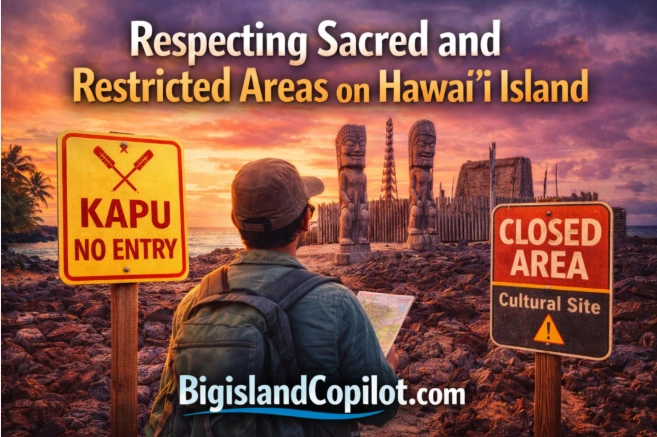
Hawaiʻi Island is not just a destination—it’s a living place with deep cultural, spiritual, and historical meaning. Many areas that visitors encounter are sacred, protected, or restricted, even if they don’t look fenced off or clearly marked.
Most visitors who cross boundaries don’t do so intentionally. They do it because they don’t understand what those boundaries mean—or that they exist at all.
This guide explains what sacred and restricted areas are, why they matter, how to recognize them, and how to explore the island respectfully without fear of “doing something wrong.”
What “Sacred” Means in Hawaiʻi
In Hawaiian culture, many places are considered wahi pana—storied or sacred places tied to:
- Ancestral history
- Spiritual practices
- Burial grounds
- Deities (akua)
- Natural forces like volcanoes, oceans, and winds
These places are not “historic ruins” or abandoned landmarks. They are actively respected, even if no ceremonies are happening at the moment.
A location may look like:
- A pile of stones
- A quiet clearing
- An unmarked trail
- A lava field
- A shoreline
But its importance isn’t visual—it’s cultural.
Sacred vs Restricted: What’s the Difference?
Sacred Areas
- May be open to pass through but not altered
- Require respectful behavior
- Often unmarked or lightly marked
- Include heiau (temples), burial grounds, and culturally significant landscapes
Restricted Areas
- Legally closed to the public
- Often protected for safety, conservation, or cultural preservation
- Entry may result in fines or arrest
- Includes closed lava fields, military zones, private land, and conservation areas
Some places are both sacred and restricted.
Why Access Isn’t Always Clearly Marked
Visitors often ask: “If it’s sacred or closed, why isn’t there a big sign?”
Reasons include:
- Cultural preference for subtlety over warning signs
- Respectful assumption that people will observe boundaries
- Protection from vandalism or overcrowding
- Remote terrain where signage isn’t practical
This can be confusing for visitors—but lack of signage does not equal permission.
Common Sacred & Protected Areas Visitors Encounter
Heiau (Ancient Hawaiian Temples)
Often stone platforms or enclosures.
Do not:
- Climb on them
- Sit or picnic on them
- Stack rocks nearby
Burial Grounds
May be marked or completely unmarked.
Human remains have been disturbed historically, making this especially sensitive.
Volcanic Areas
Mauna Kea and Mauna Loa are both geologically active and spiritually significant.
Hawaiʻi Volcanoes National Park rules:
https://www.nps.gov/havo
https://www.nps.gov/havo/planyourvisit/safety.htm
Mauna Kea: A Special Case
Mauna Kea is one of the most misunderstood places on the island.
It is:
- Sacred to Native Hawaiians
- A world-class scientific site
- A high-risk altitude environment
- Partially restricted
Visitors may access certain areas but must follow strict rules.
Official guidance:
https://maunakeaobservatories.org/visiting
https://www.nps.gov/havo/planyourvisit/mauna-kea.htm
Why Rock Stacking Is Disrespectful
Stacking rocks may feel harmless, but it:
- Alters cultural landscapes
- Disrupts ecosystems
- Can disturb burial sites
- Removes stones intentionally placed by ancestors
In many places, it’s explicitly discouraged or prohibited.
National Park guidance:
https://www.nps.gov/articles/rockcairns.htm
Private Land Isn’t Always Obvious
Much of Hawaiʻi Island is privately owned—even land that looks wild or unused.
Signs may be:
- Small
- Weathered
- Posted at trail access points, not scenic spots
Trespassing laws apply even without fences.
Hawaiʻi trespass law overview:
https://www.capitol.hawaii.gov/hrscurrent/Vol14_Ch0701-0853/HRS0708/HRS_0708-0814.htm
Why “Locals Do It” Isn’t a Good Measure
Visitors sometimes justify access by saying:
“I saw locals go there.”
Important context:
- Locals may have permission, cultural rights, or family access
- Locals may know when areas are open or closed
- What’s appropriate for residents may not be appropriate for visitors
Respect means not assuming the same access.
Environmental Protection Is Cultural Protection
Many restricted areas are closed not only for culture but for:
- Erosion control
- Native species protection
- Watershed preservation
Removing rocks, plants, sand, or lava is illegal.
Hawaiʻi DLNR rules:
https://dlnr.hawaii.gov/
https://dlnr.hawaii.gov/ecosystems/
What to Do If You’re Unsure
When in doubt:
- Don’t enter
- Don’t touch
- Don’t climb
- Don’t collect
Choose observation over interaction.
Respectful Alternatives for Visitors
You can experience Hawaiian culture respectfully by:
- Visiting museums and cultural centers
- Attending permitted cultural events
- Taking guided cultural tours
- Reading interpretive signs carefully
- Asking questions respectfully
Recommended starting points:
- Bishop Museum: https://www.bishopmuseum.org/
- Hawaiʻi Volcanoes NP cultural info: https://www.nps.gov/havo/learn/historyculture/index.htm
What Happens When Boundaries Are Ignored
Consequences may include:
- Fines
- Arrest
- Trail closures
- Increased restrictions for everyone
- Deep cultural harm
Even unintentional disrespect can have lasting effects.
Respect Is Not About Fear—It’s About Awareness
Most visitors want to do the right thing. Respecting sacred and restricted areas isn’t about perfection—it’s about listening, observing, and choosing care over curiosity.
You don’t need to understand every cultural detail to be respectful. You just need to recognize that not everything is meant to be entered, climbed, or photographed up close.
The Takeaway
Hawaiʻi Island offers incredible access to nature and culture—but access comes with responsibility. When visitors respect boundaries, they help preserve what makes the island special for future generations.
If you leave with photos, memories, and nothing taken—physically or culturally—you’ve done it right.
⚠️ Quick Safety Reminder
Conditions can change suddenly. Always check local conditions, warnings, and official guidance before entering the ocean, lava areas, or trails. Safety is your responsibility.
Aloha, did you like this page?