
⚠️ Big Island Safety Notice
The Big Island’s environment can change rapidly — ocean conditions, lava flows, weather, and trails may become dangerous without warning. This guide is for educational purposes only and does not replace real-time assessments, posted warnings, or professional guidance. Always check current conditions before entering the water, hiking, or exploring, and do not proceed if conditions appear unsafe — even if a location is described as “safer.”
Table of Contents
Table of Contents
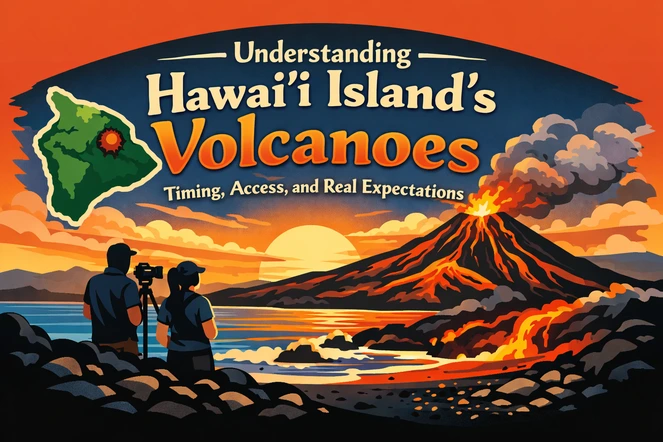
Hawaiʻi Island is shaped by volcanoes, but that does not mean lava is always visible, accessible, or safe to approach. Many visitors arrive expecting glowing flows and leave confused or disappointed because no one explained how volcanic activity here actually works.
This guide exists to provide context — not hype — so you can understand what you’re seeing, what you’re not seeing, and why.
Active Does Not Mean Erupting
One of the most confusing aspects of volcano science for the general public — and even for many travel Guides and news reports — is the use of the word “active.” Most people assume that calling a volcano “active” means lava is flowing, smoke is rising, or there’s some visible eruption happening right now. But in volcanology, the term active has a much broader, more technical meaning, and it does not necessarily mean erupting at the surface.
To understand why, you need to step back and look at how scientists define volcanic states, what kinds of activity volcanoes exhibit beneath the surface, and how monitoring systems like those of the USGS interpret signs of unrest. In Hawai’i, Kīlauea and Mauna Loa behave very differently.
1. What Does “Active” Really Mean?
At its core, an active volcano is one that has erupted in the recent geologic past and retains the potential to erupt again. This typically refers to eruptions within the Holocene Epoch — our current geological epoch spanning the last ~11,700 years. Under this convention, a volcano that last erupted thousands of years ago is still considered “active” because its magmatic system hasn’t shut down and could become active again in the future.
This global framework reflects Earth’s long geologic timescales, which don’t align well with human lifespans. For example, volcanoes classified as active include those currently erupting and also those that haven’t erupted in hundreds to thousands of years but still have the capacity to do so.
Importantly, active is different from erupting. A volcano can be active if it’s:
- currently erupting,
- showing signs of unrest beneath the surface, or
- simply classified as capable of future eruptions based on its history.
In contrast, an eruption is a specific surface phenomenon — magma reaching the surface as lava, ash, or volcanic gases visible above ground.
2. Unrest, Background Activity, and Eruptions
The USGS — through its Volcano Hazards Program — monitors volcanoes not just for eruptions, but for subtle precursors and periods of unrest. These can include:
- earthquake swarms beneath the volcano,
- inflation or deformation of the ground as magma intrudes,
- changes in volcanic gas emissions (like sulfur dioxide), or
- shifts in heat flow measured at the surface.
All of these features may indicate a magma body shifting or pressurizing underground, but none of them alone guarantee an eruption will occur.
The USGS’s alert system for U.S. volcanoes includes terms like Normal, Advisory, Watch, and Warning, where:
- Normal means background levels of activity with no immediate signs of eruption,
- Advisory signals elevated unrest above normal,
- Watch indicates heightened unrest or potential eruption conditions,
- Warning means an eruption is imminent, underway, or suspected.
This alert structure highlights a key point: volcanic unrest exists on a spectrum — and only a small part of that spectrum is an eruptive event.
3. Why a Volcano Can Be Active Without Erupting
There are several reasons a volcano may show activity without erupting:
A. Eruptive Precursors Don’t Always Lead to Eruptions
Volcanic unrest often precedes an eruption, but not always. For example, seismic swarms or ground deformation can occur as magma moves, but the system may stall before reaching the surface. In the Long Valley region of California, significant signs of unrest persisted for years without a confirmed eruption.
Similarly, peaks in seismic activity under Kīlauea have at times raised concerns about potential eruptions — yet no lava appeared at the surface, and scientists maintained monitoring without transitioning to eruptive status.
B. Background Activity Is Normal for Many Volcanoes
Many volcanoes — especially those with extensive monitoring — exhibit a baseline of seismicity, gas emission, and deformation simply because fluid and magma motion is part of their normal state. Distinguishing background activity from significant unrest requires long‑term data on typical patterns at that volcano.
This is why understanding a volcano’s normal behavior is as important as detecting anomalies — because what looks “exciting” to casual observers may just be typical background behavior to scientists.
C. Subsurface Activity May Never Manifest at the Surface
Magmatic systems are deep and complex. Magma can move within underground reservoirs or intrude short distances without ever breaking through the surface. These intrusions might cause measurable seismic or deformation signals, but they don’t always result in an eruption.
In fact, research on volcanic unrest emphasizes that signs like swarm earthquakes, inflation, and gas changes can occur without surface eruption — and these patterns vary widely among volcanoes.
4. The Challenge of Forecasting Eruptions
Forecasting volcanic eruptions — as opposed to simply detecting unrest — remains one of the most complex challenges in Earth sciences. It differs fundamentally from predicting weather:
- Forecasting (probabilistic): Provides likelihoods that a volcano may erupt within a given timeframe, based on historical and real‑time data.
- Prediction (deterministic): Attempts to specify a precise time and place of eruption — something current science has not reliably achieved.
For example, the 2022 eruption of Mauna Loa was preceded by months of subtle signs — small earthquakes and ground swelling — that indicated magma was migrating toward the surface. But scientists could not say exactly when or exactly how the eruption would begin.
These precursors gave important information about increasing likelihood, but they weren’t precise predictors in a deterministic sense.
5. What Unrest Looks Like vs. What Eruptions Look Like
Earthquakes on the Big Island are common. Understanding the difference between unrest and eruption is crucial for setting expectations:
Unrest Examples
- Elevated seismic activity without surface lava.
- Ground deformation indicating magma pressure changes.
- Increases in volcanic gas output.
- Steaming vents or fumaroles intensifying.
These may be scientifically significant signs that the system is changing — but they may not erupt for weeks, months, or even indefinitely.
Eruption Examples
- Lava flows breaking the surface and moving across the landscape.
- Explosive expulsions of ash and tephra into the atmosphere.
- New fissures appearing on the flanks or summit.
- Sudden increases in visible activity.
Only these direct surface manifestations count as eruptions, whereas unrest refers to the processes that precede or accompany them.
6. Implications for Travelers and Observers
For anyone planning to visit a volcano like those on Hawaiʻi Island, understanding the distinction between active and erupting matters:
- A volcano classified as “active” might look calm during your visit.
- You might see no lava flows or explosions even if the system is restless.
- Monitoring data showing elevated seismicity doesn’t guarantee visible activity.
- Conversely, a quiet volcano could still move toward eruption with little visible warning.
This variability is why volcano observatories like the USGS publicize real‑time data and volcano activity notices — to communicate nuanced conditions rather than binary erupting/not erupting states.
7. Why This Matters Beyond Semantics
Misunderstanding the term active can lead to anxiety, misinformation, and poor planning. Calling a volcano “active” in a news headline may spark imaginations of imminent lava flows, when in scientific terms it simply means the volcano could erupt in the future.
Volcanologists stress the importance of:
- long‑term monitoring to establish baseline behavior,
- careful interpretation of unrest signals,
- communicating uncertainty clearly to the public and officials, and
- categorizing volcanoes accurately to guide hazard awareness.
Summary: The Key Takeaways
Active ≠ erupting.
A volcano is active if it:
- has erupted in the geological past (Holocene),
- shows signs of unrest beneath the surface, or
- maintains a magmatic system capable of erupting again.
But active does not mean:
- it is currently erupting,
- magma is at the surface,
- lava flows are occurring, or
- there is guaranteed imminent eruption.
Volcanic systems operate across deep timescales and complex internal dynamics. Even with sophisticated monitoring, scientists often forecast probabilities rather than predict certainties. Interpreting unrest — and its implications for both hazards and visitor expectations — requires appreciating that surface eruptions are only one part of a much larger picture of volcanic behavior.
Eruption History and What It Means for Visitors
If you’re planning a visit to Hawaiʻi Island because you’ve heard about volcanic activity, it’s important to understand what has actually been happening — not just sensational headlines. In the past couple of years, volcanic activity on the Big Island has been among the most dynamic in decades, especially at Kīlauea within Hawaiʻi Volcanoes National Park. But recent history also shows why visitors need grounded expectations about what they will see, where they can go, and how volcanic behavior can change quickly based on real science.
Kīlauea’s Recent Activity: A Dynamic, Episodic Eruption Cycle
Kīlauea has been one of the most closely watched volcanoes in the world, partly because it is erupting now — but also because of how it’s erupting. According to the U.S. Geological Survey (USGS), Kīlauea’s current eruptive phase began on December 23, 2024, with ongoing intermittent activity in the summit crater of Halemaʻumaʻu.
What does intermittent mean in practice? Since late 2024 and into 2025, the eruption hasn’t been a continuous flood of lava. Instead, it consists of multiple short‑lived eruptive episodes separated by pauses:
- These episodes usually last just hours and then stop for several days before restarting.
- During eruptive episodes, lava fountains can rise high above the crater floor, sometimes hundreds of feet into the air before activity wanes.
- The eruption has already produced dozens of separate events, with around 30+ episodes reported through 2025 as volcanologists track each one.
This pattern — short bursts of a1ctivity with breaks in between — is typical for Kīlauea’s summit eruptions, and it’s why visitors sometimes see lava fountains one day and nothing yet dramatic the next.
What this means for visitors:
Even though the volcano is “erupting,” literal lava flows and fountains are not constant. That’s why a live eruption does not guarantee that your visit will coincide with dramatic lava scenes — but it does mean that there are frequent opportunities to witness volcanic activity when conditions align with your trip dates.
Beyond Halemaʻumaʻu — Rift Zone Events in 2024
Before the current summit eruption phase, Kīlauea also showed activity elsewhere in 2024:
- In June 2024, magma moved down Kīlauea’s Southwest Rift Zone, producing a brief eruption outside the summit.
- In September 2024, another eruption occurred in the middle East Rift Zone near Nāpau Crater for several days.
These rift zone eruptions were relatively short and away from major visitor access areas, but they highlight that Kīlauea’s activity isn’t limited to the summit. Rift zone eruptions are often more unpredictable and can change access conditions rapidly if they occur closer to roads or trails.
Visitor takeaway:
While most public viewing occurs from safe zones around Halemaʻumaʻu within Hawaiʻi Volcanoes National Park, activity outside the summit can happen, and that sometimes alters where you can safely travel. USGS and park updates must be checked before planning your route. (Links at end of section)
Mauna Loa — The Sleeping Giant With Recent History
While Kīlauea has been the headline on volcanism in recent years, Mauna Loa — the largest active volcano on Earth — also has a place in recent history:
- Mauna Loa’s most recent eruption began on November 27, 2022, and was its first in decades.
- After that brief eruptive period, activity subsided and Mauna Loa’s alert status returned to Normal — meaning no active surface eruption as of late 2025.
Mauna Loa’s scale and power are immense, and if it enters a new active phase near populated areas, it can have widespread effects. But for now, Kīlauea’s frequent summit activity is the main focus for visitors.
Patterns and Frequencies Over Recent Years
To put recent Big Island volcanism into context:
- 2020–2021: Summit collapse and subsequent eruptions began reshaping Halemaʻumaʻu.
- 2023: Multiple summit eruptions occurred, some lasting weeks.
- 2024: Rift zone and summit activity continued, culminating in the December 23 summit eruption.
- 2025: The same summit eruption cycle persisted into late 2025 with many episodic events — each separated by relatively calm intervals.
This history shows that volcanic activity today is part of a broader multi-year trend, not a sudden “new” phenomenon. Visitors during high tour seasons should expect some eruptive episodes during any given year now that the volcano has entered this sustained, episodic phase.
What Recent Activity Means for Visiting Safely
From a visitor standpoint, here’s how recent eruption history translates into real expectations:
1. Timing can’t be guaranteed
Even during an active eruption phase, lava fountains and visible flows are intermittent. Some episodes occur while others are paused. You might visit during a break in surface activity and still be within an eruption cycle.
2. Visibility is often dramatic — when it happens
During eruptive episodes, lava fountains have reached hundreds of feet or more above the crater floor. Some events in 2025 produced exceptionally high fountains confined to the summit crater.
3. Most activity stays within the National Park boundaries
The ongoing summit eruption — and virtually all recent events — have remained within Hawaiʻi Volcanoes National Park, not threatening residential areas.
4. Hazards extend beyond lava
Even when lava isn’t visible:
- Volcanic gas (vog) can affect air quality downwind of the park.
- Tephra and Pele’s hair (fine volcanic glass strands) can be carried by wind, posing eye or skin irritation risks around viewing areas.
Using Real‑Time Data to Plan Your Visit – Links
Because Kīlauea’s recent eruption is episodic rather than constant, the best way to time your visit is by relying on real‑time monitoring:
Official sources worth bookmarking and checking frequently:
- USGS Kīlauea page: https://www.usgs.gov/volcanoes/kilauea/volcano-updates
- Current alerts & updates: https://www.usgs.gov/programs/VHP/volcano‑updates
- Live webcams: https://www.youtube.com/@usgs/streams
These give daily reports, hazard notices, and visual confirmation of activity so you can choose the best days for dramatic volcanic viewing.
Summary: How Recent Eruptions Shape Visitor Expectations
In the last few years, Kīlauea has entered a period of frequent eruptive activity that visitors can observe — but not continuously. Volcano behavior has oscillated between dramatic lava fountain episodes and calmer intervals, and this pattern is likely to continue. While Mauna Loa has shown activity in the recent historical record (2022), it is currently not erupting.
For visitors, this means:
✔ Active but intermittent eruption cycles offer multiple chances to see lava activity.
✔ Eruptions are largely confined within Hawaiʻi Volcanoes National Park, not threatening most communities.
✔ Hazards extend beyond visible lava — volcanic gas and airborne material remain important considerations.
✔ Real‑time data is essential for planning your visit if seeing lava is a priority.
Real-Time Resources for Visiting Hawaiʻi Island Volcanoes – Links
1. Live Kīlauea Webcams
Stay up to date with visual confirmation of volcanic activity at the summit and rift zones.
🔗 View Live Webcams
2. Current USGS Volcano Updates
Official alerts, notices, and summaries of ongoing volcanic activity.
🔗 Check Current Alerts
3. Hawaiʻi Volcanoes National Park Conditions
Park closures, trail access, and visitor safety information.
🔗 Park Conditions & Updates
4. Volcano Alert Levels Explained
Learn what USGS alert levels mean and how they affect safety and access.
🔗 Volcano Alert Levels
5. Air Quality and Vog Information
Check the impacts of volcanic gases on air quality before visiting.
🔗 Hawaiʻi Air Quality & Vog Updates
When Is the Best Time to Visit?
Understanding when to visit volcanic areas on the Big Island requires separating volcanic activity itself from the visitor experience.
Current Reality (2025–2026)
Since December 23, 2024, Kīlauea’s summit within Hawaiʻi Volcanoes National Park has been in a phase of episodic eruptive activity — with multiple short-lived lava fountain episodes separated by pauses. Many of these episodes last hours to a few days, and pauses between episodes may also be days long.
USGS has maintained the volcano’s alert level at WATCH with an Aviation Color Code of ORANGE, meaning hazardous activity is possible and being actively monitored.
During these episodes, lava fountains and incandescent areas may be visible at designated overlooks inside the park, but conditions can change quickly — activity stops, resumes, or shifts with little warning.
I highly suggest subscribing to the Volcano Notification Service. Once subscribed, you can modify your settings to only include Hawaiian volcanoes.
Visit Timing Considerations
Timing a visit to Hawaiʻi Island’s volcanoes requires more than simply checking a calendar; it’s about understanding the rhythm of volcanic activity and aligning your expectations with what the landscape is actually doing. Even during an eruptive phase, activity at Kīlauea or Mauna Loa is rarely constant, so planning a visit is a balance between real-time monitoring, seasonal considerations, and personal flexibility.
Volcanoes like Kīlauea operate on episodic cycles. While the current summit eruption began in late 2024, the flow of lava, the height of fountains, and the intensity of gas emissions fluctuate daily. Some days, the crater may produce dramatic fountains visible from the park’s overlooks, while other days may be quiet, offering only the sight of steaming vents or fresh lava fields. This unpredictability makes monitoring current conditions essential for visitors hoping to witness active lava. Checking USGS updates and live webcams before and during your trip provides the clearest picture of whether you are likely to encounter surface eruptions or simply the calm beauty of volcanic terrain.
Seasonal factors also play a role. The Big Island’s climate shifts between wetter and drier months, affecting visibility. Trade winds carry volcanic gas and vog in predictable patterns, which can obscure views or impact health, particularly for those with respiratory sensitivities. Visiting when trade winds push gas away from viewing areas improves the chance of clear skies and safer conditions. Additionally, volcanic activity sometimes coincides with sudden park closures or restricted access to trails and lookout points. Flexibility in your itinerary, including willingness to adjust plans based on the latest advisories, ensures both safety and a more rewarding experience.
Time of day can further enhance your experience. Sunrise and sunset provide dramatic lighting that highlights lava glow or steaming craters, making intermittent activity more striking and photogenic. Nighttime visits, where allowed, can reveal the subtle glow of lava even when eruptions are modest, giving an entirely different perspective on the volcano’s power. Understanding these cycles and combining them with live monitoring allows visitors to maximize their chances of witnessing activity without assuming that the volcano will erupt continuously during their stay.
Ultimately, the best approach is to plan visits with both patience and awareness. A single visit may capture moments of active lava, steaming craters, and newly formed lava flows, or it may offer a quieter view of the dramatic, rugged landscape shaped by repeated eruptions over decades. By respecting the natural variability of volcanic behavior and aligning your schedule with real-time information, visitors can experience Hawaiʻi Island’s volcanoes safely and meaningfully, gaining a deeper appreciation for the forces that continuously reshape the land.
Even when lava is visible, parking and crowds can fill early, and ranger-directed closures may restrict access to the best viewpoints.
Between eruptive episodes
Because the current pattern includes frequent pauses between episodes, visiting during a lull doesn’t mean nothing is happening — it can mean:
- Cooler lava flows that are still visible
- Excellent context for interpreting older lava fields
- Safer walking conditions
- Better lighting for photos
This is often ideal for most visitors who don’t want to chase eruptions.
Practical View Recommendation
The most important thing if you care about seeing active activity is information, not timing:
✔ Check the official USGS Hawaiian Volcano Observatory updates before you leave and during your visit.
✔ Watch the USGS live webcams — they show current conditions in real time.
✔ Assume that any visible activity may change before, during, or after your visit.
This island’s volcanic behavior doesn’t follow a predictable schedule, even in the current phase. Thus, the best planning strategy is to plan for a meaningful visit regardless of whether eruption visuals occur that day — because the landscape itself, its context, and its scale are remarkable in their own right.
Summary Guidance
If you want a reliable experience without chasing conditions, visit established overlooks and interpretive spots anytime — even between eruptive episodes.
Don’t plan a trip solely to “see lava” — tie your visit to broader experiences and realistic expectations.
If you want the best chance of seeing activity, monitor USGS alerts and webcams daily while you’re here.
Where Visitors Actually Go
Hawaiʻi Volcanoes National Park (HVNP)
This is the best starting point for most visitors.
You’ll see:
- Large craters
- Lava tubes
- Steam vents
- Lava fields of different ages
What surprises people:
- The scale
- The quiet
- How quickly weather changes
Plan for:
- Half day minimum
- Full day recommended
Kaʻū and South Island Lava Fields
Older flows, fewer people, and very limited services, including cell service.
Expect:
- Strong wind
- Open exposure
- Long distances between stops
This is not a casual detour — plan deliberately.
Practical Logistics Most People Miss
🚽 Bathrooms: The “Point of No Return”
Reliable, plumbed restrooms are rare once you leave the main hubs. Most places utilize porta-potty units. On the long stretch of Highway 11 between Volcano and South Kona, you can go 40+ miles without a public facility.
Best places to stop with Google Maps links:
- HVNP Visitor Center: Kīlauea Visitor Center (Currently undergoing renovations; use the temporary facilities at the Kilauea Military Camp).
- Chain of Craters Road: Plumbed toilets are at the Mauna Ulu Parking Lot and vault toilets at the Hōlei Sea Arch (End of the road).
- Punaluʻu Black Sand Beach: Public Restrooms
- Naʻalehu: Stop at the Punaluʻu Bake Shop for a bathroom break and a snack.
- Wai’ōhinu Park in Na’alehu has multiple bathrooms and water.
- Ocean View Market typically has a porta-potty or two unlocked daily during business hours.
- Choicemart shopping area in captian cook has a public bathroom. Choicemart itself does not have public restrooms, but there are public restrooms located in the shopping complex.
- Kahuku Gift And Garden in Ocean View has a bathroom in the back of the store where the outdoor plants are.
⛽ Gas: The “Island Distance” Trap
Gas stations are non-existent inside the National Park and sparse in the rural south. “Running low” here is dangerous because of the steep elevation changes that drain fuel faster than flat-road driving.
When driving anywhere on the island, please keep in mind that only you are on vacation, and that residents are on a different schedule, but we all have to use the same 2 lane road. So when you see a line of cars behind you, show some Aloha and use one of the many pull off areas, and let them go by.
Fill up completely at these points:
- Hilo Side: Volcano Village (Last stop before entering the park).
- South Point/Kaʻū Area: Naʻalehu or Ocean View.
- Distance Warning: It is 40+ miles (roughly 1 hour) from Volcano Village to the next reliable station in Naʻalehu. If you are under 1/4 tank, do not descend Chain of Craters Road (38 miles round trip).
Note: Signs to Pahala indicate that gas is available, but the station closed many years ago, so disregard stopping in Pahala for gas.
💧 Food and Water: Self-Sufficiency is Key
There are no vending machines or concessions once you leave the Kīlauea summit area.
The Ocean View Market is the last place to get decent deli food or ice before hitting the long lava stretches of South Kona. Be prepared for food and beverage prices to be at least double those of Hilo or Kona. Malama Market, also in Ocean View will be higher than Ocean View Market.
In the same shopping area as Ocean View Market, you’ll also find a coffee shop that sells food and drinks.
Our go-to place for snacks in Ocean View is Kahuku Country Market, as they also offer custom coffees, milkshakes, floats, and smoothies. Many times, they also have a cooler with fresh-caught and prepared local fish, ready to cook. Oh, and their prices are better in line than the others.
Water: Bring 2 liters per person if hiking. You can refill at the Kīlauea Visitor Center (filtered rainwater) or the KMC General Store.
Groceries: KTA Super Stores in Hilo or Choice Mart in Captain Cook are your best “big” stops.
Safety on Lava Terrain
Lava:
- Retains heat
- Breaks unpredictably
- Is extremely abrasive
- Reflects intense sunlight
Common issues include ankle injuries, cuts, dehydration, and heat exhaustion. Rescues can take hours.
Cultural Context Matters
For many local families, lava is not scenery — it is a living force tied to history and identity.
- Do not remove lava rocks
- Respect closures
- Stay off private land
This isn’t about rules. It’s about respect.
Hawaiʻi Island rewards patience, curiosity, and preparation. Volcanoes here are powerful, slow, and unpredictable — and that is exactly what makes the island what it is.
Arriving informed often leads to a deeper experience than chasing spectacle.
⚠️ Quick Safety Reminder
Conditions can change suddenly. Always check local conditions, warnings, and official guidance before entering the ocean, lava areas, or trails. Safety is your responsibility.
Aloha, did you like this page?