
⚠️ Big Island Safety Notice
The Big Island’s environment can change rapidly — ocean conditions, lava flows, weather, and trails may become dangerous without warning. This guide is for educational purposes only and does not replace real-time assessments, posted warnings, or professional guidance. Always check current conditions before entering the water, hiking, or exploring, and do not proceed if conditions appear unsafe — even if a location is described as “safer.”
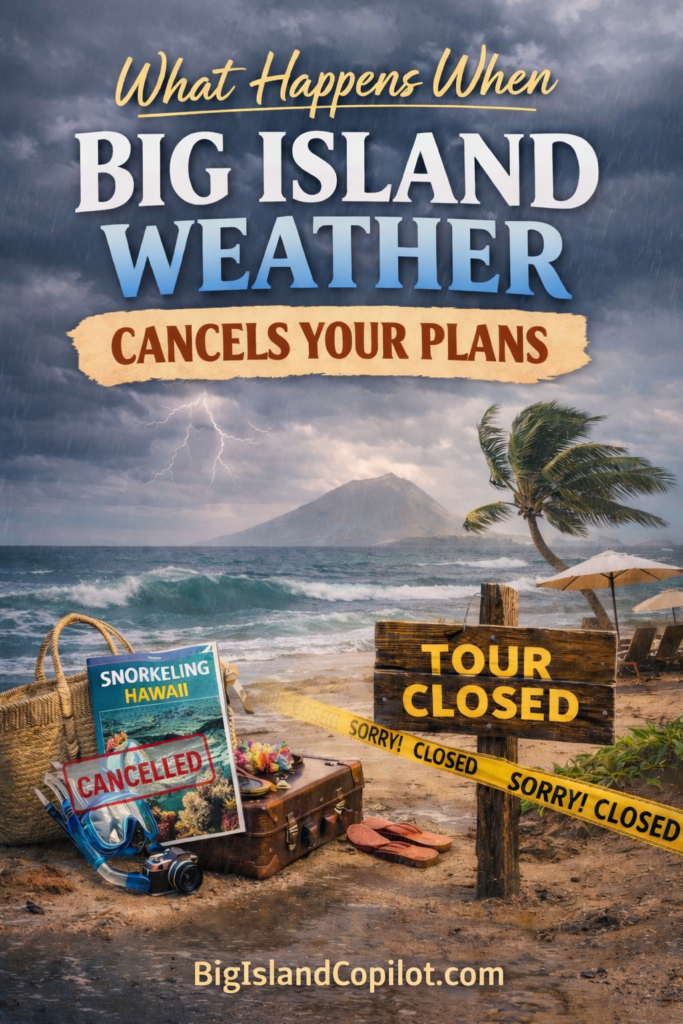
Bad weather on Hawaiʻi Island doesn’t mean a ruined trip — it means you’re About to experience the island the way locals actually live it.
This guide exists because Big Island weather cancels plans here all the time. Roads close. Tours stop running. Beaches become unsafe. Volcano views disappear into fog.
The visitors who struggle are the ones who didn’t plan for flexibility.
The visitors who thrive? They know how to pivot.
This is your go‑to, saveable, shareable guide for exactly what to do when the weather doesn’t cooperate.
First: Understand Why Weather Cancels Plans Here
Hawaiʻi Island has:
- Massive elevation changes
- Active volcanoes
- Trade winds and winter swells
- Microclimates stacked side by side
You can have sunshine in Kona while Hilo floods, fog at Volcano while Waimea freezes, and high winds on Saddle Road while the coast is calm.
Big Island weather cancellations are normal — not bad luck.
Common Weather Problems (And What They Actually Cancel)
🌧 Heavy Rain
Cancels or affects:
- Waterfall hikes (flash flooding risk)
- Lava tube access
- Muddy trails
- Some helicopter tours
Still possible:
- Scenic drives
- Museums
- Food-focused days
🌫 Fog & Low Clouds
Cancels or affects:
- Volcano crater views
- Stargazing
- Mauna Kea summit trips
Still possible:
- Rainforest walks
- Coffee tastings
- Coastal exploration
🌊 High Surf & Strong Currents
Cancels or affects:
- Swimming
- Snorkeling
- Boat tours
Still possible:
- Tide pooling (protected areas)
- Coastal overlooks
- Beach walks
🌬 High Winds
Cancels or affects:
- Helicopter tours
- Summit drives
- Some zipline tours
Still possible:
- Farmers markets
- Scenic town exploration
- Food tours
The Golden Rule: Change Regions, Not the Whole Day
Do not cancel the day — change where you are.
If It’s Raining in Hilo → Go West
- Kona coast beaches
https://maps.google.com/?q=Kailua-Kona - Coffee country
https://maps.google.com/?q=Holualoa+Hawaii
If Kona Is Cloudy → Go East
- Hilo town
https://maps.google.com/?q=Hilo+Hawaii - Botanical gardens
https://maps.google.com/?q=Hawaii+Tropical+Botanical+Garden
If Volcano Is Fogged In → Go Low Elevation
- Punaluʻu Black Sand Beach
https://maps.google.com/?q=Punaluu+Black+Sand+Beach - South Point
https://maps.google.com/?q=South+Point+Hawaii
Incredible Things to Do When Outdoor Plans Fall Apart
1. Scenic Drives (Rain Is a Feature)
Rain makes the island greener, waterfalls fuller, and lava landscapes more dramatic.
Best routes:
- Saddle Road (Daniel K. Inouye Hwy)
https://maps.google.com/?q=Daniel+K+Inouye+Highway - Hamakua Coast Drive
https://maps.google.com/?q=Hamakua+Coast
2. Museums & Indoor Learning (Highly Underrated)
- ʻImiloa Astronomy Center
https://maps.google.com/?q=Imiloa+Astronomy+Center - Lyman Museum & Mission House
https://maps.google.com/?q=Lyman+Museum - Pacific Tsunami Museum
https://maps.google.com/?q=Pacific+Tsunami+Museum
These give context to everything you’re seeing outside.
3. Food-Focused Pivot Days (Locals’ Favorite Option)
When Big Island weather hits, locals eat.
Farmers Markets
- Hilo Farmers Market
https://maps.google.com/?q=Hilo+Farmers+Market - Waimea Midweek Farmers Market
https://maps.google.com/?q=Waimea+Farmers+Market
Food Truck Zones
- Pau Hana Market (Kona)
https://maps.google.com/?q=Pau+Hana+Market+Kona
4. Coffee, Chocolate & Farm Tours (Rain-Proof)
- Greenwell Farms Coffee Tour
https://maps.google.com/?q=Greenwell+Farms - Hāmākua Chocolate Farm
https://maps.google.com/?q=Hamakua+Chocolate+Farm
Most are short, sheltered, and operate rain or shine.
5. Lava Tubes & Geology Stops (When Safe)
Rain outside doesn’t always affect underground experiences.
- Nāhuku (Thurston Lava Tube)
https://maps.google.com/?q=Thurston+Lava+Tube
Check park alerts first.
6. Town Wandering (Slow Travel Wins)
Bad weather days are perfect for wandering.
- Hilo town shops & cafes
https://maps.google.com/?q=Downtown+Hilo - Waimea galleries
https://maps.google.com/?q=Waimea+Town
What NOT to Do When Big Island Weather Cancels Plans
- Don’t trespass for views
- Don’t hike closed trails
- Don’t drive through flooded roads
- Don’t chase waterfalls in storms
No photo is worth a rescue.
Build Weather Buffer Days Into Your Trip
This is one of the most important planning concepts for Hawaiʻi Island, and it’s the difference between a stressful trip and a great one.
A weather buffer day is a day with no fixed reservations. It exists purely to absorb weather changes, road closures, or last‑minute opportunities.
Why Buffer Days Matter More on the Big Island
Unlike smaller islands, the Big Island has:
- Long drive times between regions
- Elevation changes that affect weather hourly
- Volcano-related closures
- Ocean conditions that change daily
If you stack every day with paid tours, one bad weather system can domino into multiple lost experiences.
Buffer days stop that cascade.
How Many Buffer Days You Actually Need
- 4–5 day trip: at least 1 buffer day
- 6–8 day trip: 2 buffer days
- 9+ day trip: 2–3 buffer days
These are not “wasted” days — they’re flex days.
Where to Place Buffer Days (This Is Key)
Put buffer days:
- After high‑priority activities (volcano visits, Mauna Kea, snorkeling)
- Near the middle of your trip, not just the end
- In regions with lots of short‑notice options (Hilo, Kona, Waimea)
Avoid putting all buffer days at the very end — weather patterns don’t wait politely.
What a Buffer Day Actually Looks Like
A buffer day might become:
- The day you finally get clear volcano views
- A calm beach day after rough surf passes
- A slow food‑focused day you didn’t plan
- The day you drive somewhere you hadn’t even heard of
Many visitors later say their favorite day was the one they didn’t plan.
What NOT to Book on Non‑Buffer Days
Try to avoid booking these back‑to‑back without flexibility:
- Helicopter tours
- Summit experiences
- Boat tours
- Long guided hikes
If you do book them, separate them with a buffer day whenever possible.
Local Reality Check
Locals plan life around weather here.
If rain cancels one plan, they don’t panic — they pivot.
Buffer days let visitors do the same instead of feeling like something was “taken” from their trip.
The Hidden Benefit of Buffer Days
They lower stress.
You stop watching the forecast obsessively. You stop racing the clock. You start noticing what’s actually around you.
These often become trip highlights.
Tools to Check Before You Pivot
- NOAA Hawaii Forecasts
https://www.weather.gov/hfo/ - Hawaiʻi County Road Closures
https://www.hawaiicounty.gov - Hawaiʻi Volcanoes National Park Alerts
https://www.nps.gov/havo
The Mindset That Changes Everything
Weather doesn’t cancel the Big Island.
It reveals different versions of it.
Rain brings waterfalls.
Clouds bring mystery.
Wind clears the air.
If you stop fighting the plan change, you’ll often end up with the day you remember most. This is the Big Island; it rains.
That’s not bad luck.
That’s Hawaiʻi Island being Hawaiʻi Island.
⚠️ Quick Safety Reminder
Conditions can change suddenly. Always check local conditions, warnings, and official guidance before entering the ocean, lava areas, or trails. Safety is your responsibility.
Aloha, did you like this page?