
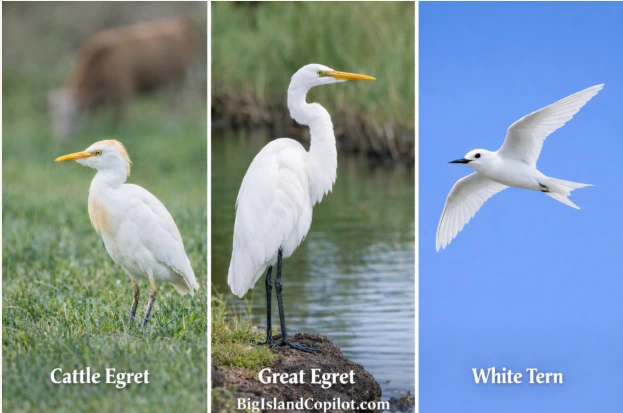
Hawaiʻi’s Big Island is a paradise not just for its lush landscapes and volcanic vistas, but also for the remarkable birds that call it home. Among the island’s diverse avian residents, the striking white birds—graceful egrets, nimble terns, and ubiquitous cattle egrets—stand out as both symbols of natural beauty and fascinating subjects for birdwatchers.
Whether wading silently through wetlands, patrolling coastal skies, or strolling across grassy pastures,
these birds offer a glimpse into the island’s unique ecosystems and the delicate balance between native and introduced species. In this guide, we’ll explore the Big Island’s most commonly seen white birds, helping you identify them, understand their habits, and appreciate their role in Hawaiʻi’s vibrant wildlife.
1. Cattle Egret (Cattle Egret)
Identification
- Medium-sized white bird, about 46–56 cm (18–22 in) long
- Yellow to orange bill, legs pale gray to yellow
- Breeding season: small orange-buff plumes appear on head, chest, and back
- Flies with neck tucked in, unlike the Great Egret
Habitat on the Big Island
- Open grasslands, golf courses, parks, roadsides
- Frequently around livestock (cattle, horses) feeding on insects stirred up by the animals
- Can also be seen in urban lawns or school fields
Behavior
- Feeds mostly on insects and small invertebrates
- Often seen walking slowly on grass, sometimes standing still for long periods
- Highly social, forming large roosting flocks in the evenings
Interesting Facts
- Introduced to Hawaiʻi in 1959 to control pests in pastures
- Adapts well to human-modified landscapes
- Roosts can be huge, sometimes hundreds of birds in a single tree
2. Great Egret (Great Egret)
Identification
- Large white bird, up to 102 cm (40 in) long, wingspan ~1.3–1.7 m
- Long S-shaped neck and slender yellow bill
- Black legs and feet, long neck makes it very distinctive
- Breeding season: develops long ornamental plumes on back
Habitat on the Big Island
- Freshwater ponds, wetlands, streams, rice fields
- Shorelines, marshes, and occasionally coastal areas
- Prefers shallow water for wading and hunting
Behavior
- Hunts by standing still or slowly stalking prey in water
- Eats fish, frogs, and small invertebrates
- Flies with long, slow wingbeats, neck tucked in
Interesting Facts
- Native to Hawaiʻi
- Unlike the Cattle Egret, less commonly seen inland
- Can be solitary or in small groups, rarely huge flocks
3. White Tern (White Tern)
Identification
- Small, all-white seabird, 28–35 cm (11–14 in) long
- Black eyes with subtle black bill
- Long wings and tail for graceful gliding flight
- Never seen walking on the ground; almost always in the air
Habitat on the Big Island
- Coastal areas, cliffs, and forest edges near the shore
- Nests in trees or shrubs, often without a platform (eggs can sit on bare branches)
- Frequently seen hovering above roads, beaches, and near settlements
Behavior
- Feeds on small fish and squid, catching them mid-flight
- Excellent flyers, often hovering in place or performing acrobatics
- Known for gentle and elegant gliding
Interesting Facts
- Also called the “White Fairy Tern”
- Famous for laying eggs on bare branches, relying on parents’ balance to prevent falling
- Less common than egrets, but very photogenic and symbolic of Hawaiʻi’s coasts
Comparison Table
| Feature | Cattle Egret | Great Egret | White Tern |
|---|---|---|---|
| Size | Medium (46–56 cm) | Large (up to 102 cm) | Small (28–35 cm) |
| Bill | Yellow-orange | Yellow, long and sharp | Black, small |
| Legs | Yellow/gray | Black | Not for walking |
| Neck in Flight | Tucked | Tucked | Extended |
| Habitat | Grasslands, parks, pastures | Wetlands, ponds | Coastal trees, cliffs |
| Diet | Insects | Fish, frogs | Small fish, squid |
| Social | Very social, large flocks | Solitary or small groups | Often solitary, aerial |
| Seen on Ground | Yes | Wades in shallow water | No |
Tips for Birdwatching on the Big Island
- Best Time: Early morning and late afternoon for feeding flocks.
- Locations:
- Cattle Egret: near pastures, golf courses, and roadsides.
- Great Egret: near ponds, rivers, and wetland areas.
- White Tern: coastal cliffs, Kahaluʻu Beach, Hilo shoreline.
- Photography Tips:
- Use long lenses for egrets in wetlands.
- For White Terns, high shutter speeds capture mid-air grace.
- Conservation: All three are protected under Hawaiʻi state laws, but Cattle Egrets are non-native and extremely abundant.
Aloha, did you like this page?