
⚠️ Big Island Safety Notice
The Big Island’s environment can change rapidly — ocean conditions, lava flows, weather, and trails may become dangerous without warning. This guide is for educational purposes only and does not replace real-time assessments, posted warnings, or professional guidance. Always check current conditions before entering the water, hiking, or exploring, and do not proceed if conditions appear unsafe — even if a location is described as “safer.”
Table of Contents
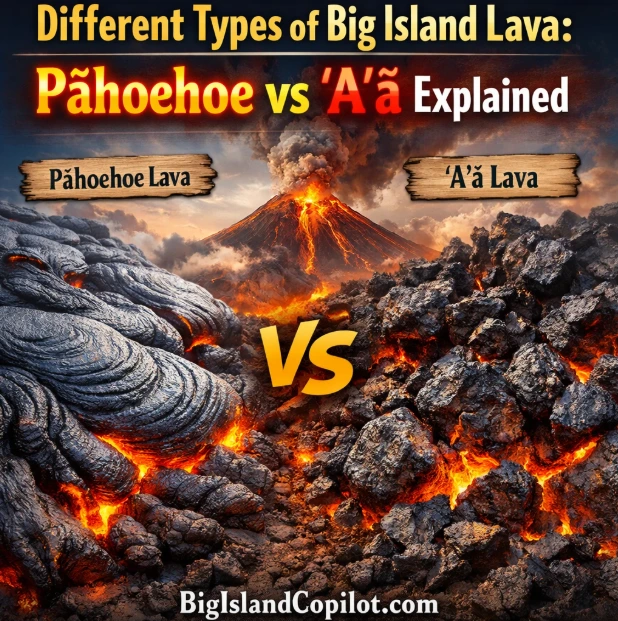
The Big Island of Hawaiʻi is one of the few places on Earth where you can clearly see different types of lava frozen in motion. From smooth, ropy surfaces to jagged Big Island lava fields that look almost hostile, these lava types tell a story about how magma moves, cools, and reshapes the island.
Two lava types dominate the Big Island’s landscape: pāhoehoe and ʻAʻā. While they come from the same volcanoes and the same molten source, they behave very differently — and understanding the difference helps visitors read the land, stay safe, and better appreciate Hawaiʻi’s geology.
This guide explains what pāhoehoe and ʻAʻā are, how they form, how to identify them, and why they matter.
Why Big Island Lava Has So Much Variety
The Big Island sits directly over the Hawaiian hotspot, producing basaltic lava that is:
- Low in silica
- Extremely hot
- Very fluid compared to lava elsewhere in the world
Because of this, Hawaiian volcanoes create effusive eruptions rather than explosive ones. Lava flows outward, cools, and solidifies in distinct ways depending on temperature, slope, speed, and gas content.
Those variables are what create pāhoehoe and ʻAʻā.
Pāhoehoe Lava: Smooth, Ropy, and Deceptive
What Is Pāhoehoe?
Pāhoehoe (pronounced pa-hoy-hoy) is lava that cools slowly while remaining highly fluid. As the surface cools, the molten lava underneath continues to move, creating smooth, folded, or rope-like textures.
This is the lava most people imagine when they think of classic Hawaiian lava flows.
How Pāhoehoe Forms
Pāhoehoe forms when:
- Big Island Lava is very hot
- Flow is slow and steady
- Terrain slope is gentle
The surface cools into a thin crust, while liquid lava beneath keeps moving, wrinkling and folding the surface like soft taffy.
How to Identify Pāhoehoe in the Field
Look for:
- Smooth, rounded surfaces
- Rope-like coils and folds
- Shiny or glassy crusts in places
- Gently rolling lava shapes
You’ll commonly see pāhoehoe in:
- Hawaiʻi Volcanoes National Park
- Along Chain of Craters Road
- Older lava flows that allowed slow cooling
Why Pāhoehoe Is More Dangerous Than It Looks
Despite its smooth appearance, pāhoehoe can be extremely hazardous:
- Thin crusts may hide voids or lava tubes
- Surface can collapse under weight
- Sharp edges beneath the crust can cause serious injury
This is why park officials strictly prohibit walking off marked trails, even on “flat-looking” lava.
ʻAʻā Lava: Rough, Jagged, and Brutal
What Is ʻAʻā?
ʻAʻā (pronounced ah-ah, often explained as the sound people make walking on it) is lava that cools faster and more violently, breaking into sharp, angular fragments as it moves.
It forms Big Island lava fields that are nearly impossible to walk across safely.
How ʻAʻā Forms
ʻAʻā forms when:
- Lava cools more rapidly
- Flow speed increases
- Terrain becomes steeper or more chaotic
As lava loses heat and gas, it becomes thicker and starts to tear itself apart while still moving.
How to Identify ʻAʻā in the Field
Look for:
- Jagged, broken surfaces
- Sharp, clinkery rocks
- Angular blocks stacked on each other
- No smooth or ropy textures
ʻAʻā is common on:
- Steeper slopes of Mauna Loa
- Faster-moving lava channels
- Older flows where lava fragmented aggressively
Why ʻAʻā Is Extremely Dangerous
ʻAʻā is one of the most hostile natural surfaces you’ll encounter:
- Razor-sharp edges
- Extremely unstable footing
- Easy to suffer deep cuts or broken ankles
Even trained researchers avoid walking across ʻAʻā whenever possible.
Pāhoehoe vs ʻAʻā: Side-by-Side Comparison
| Feature | Pāhoehoe | ʻAʻā |
|---|---|---|
| Texture | Smooth, ropy | Rough, jagged |
| Flow speed | Slow | Faster |
| Cooling | Gradual | Rapid |
| Walkability | Looks safe, often isn’t | Obviously dangerous |
| Lava tubes | Common | Rare |
| Common locations | Gentle slopes, older flows | Steep terrain, active channels |
Big Island Lava Can Change Type Mid-Flow
One of the most fascinating facts about Big Island lava is this:
Pāhoehoe can turn into ʻAʻā — but ʻAʻā rarely turns back into pāhoehoe.
As lava travels:
- It cools
- Loses gas
- Thickens
When conditions change, a smooth pāhoehoe flow can suddenly break apart and become ʻAʻā. This is why lava fields often show both textures side by side.
Lava Tubes: A Pāhoehoe Feature
Lava tubes form almost exclusively from pāhoehoe flows.
Here’s how:
- A pāhoehoe flow crusts over
- Lava continues flowing beneath
- The molten interior drains away
- A hollow tube remains
These tubes can stretch for miles, carrying lava efficiently toward the ocean.
⚠️ Lava tubes are extremely dangerous and often protected. Many collapses occur without warning.
How Lava Type Shapes the Landscape
Pāhoehoe Landscapes
- Gently rolling terrain
- Easier for plants to colonize
- More likely to develop soil over time
ʻAʻā Landscapes
- Harsh, angular terrain
- Slower ecological recovery
- Difficult for humans and animals to traverse
This difference is why some lava fields turn green relatively quickly, while others remain barren for decades.
Why Lava Type Matters for Visitors
Understanding Big Island lava types helps you:
- Recognize unsafe terrain
- Understand why trails exist where they do
- Appreciate why closures are enforced
- Read eruption history written into the rock
It also explains why lava viewing is rare and tightly controlled.
(Internal link opportunity: Why Lava Viewing Is Rare — and Why That’s Actually a Good Thing)
Common Myths About Big Island Lava Types
Myth: Smooth lava is safe to walk on
Reality: Pāhoehoe can collapse without warning
Myth: ʻAʻā only exists near active eruptions
Reality: ʻAʻā fields can persist for centuries
Myth: Big Island Lava rock is the same everywhere
Reality: Texture tells you exactly how the lava flowed
Where You’ll Commonly See Each Type
- Pāhoehoe:
- Chain of Craters Road
- Kīlauea summit area
- Lava fields near older flows
- ʻAʻā:
- Steeper Mauna Loa slopes
- Fast-moving historic flows
- Exposed rift zones
Always check park conditions and closures before exploring:
https://www.nps.gov/havo/planyourvisit/conditions.htm
Why Learning Lava Types Changes How You See the Island
Once you understand pāhoehoe and ʻAʻā, the Big Island becomes a readable landscape:
- Smooth flows tell stories of calm, sustained eruptions
- Jagged fields record violent movement and rapid cooling
- Every flow is a snapshot of the volcano’s behavior at that moment
You’re no longer just looking at black rock — you’re reading Hawai’i’s geological history written in stone.
Key Takeaways
- The Big Island is dominated by pāhoehoe and ʻAʻā lava
- Both form from the same magma under different conditions
- Pāhoehoe looks safe but can be deceptively dangerous
- ʻAʻā is visibly hazardous and extremely difficult to traverse
- Lava types shape ecosystems, trails, and safety rules
- Understanding Big Island lava improves safety and appreciation
⚠️ Quick Safety Reminder
Conditions can change suddenly. Always check local conditions, warnings, and official guidance before entering the ocean, lava areas, or trails. Safety is your responsibility.
Aloha, did you like this page?