
⚠️ Big Island Safety Notice
The Big Island’s environment can change rapidly — ocean conditions, lava flows, weather, and trails may become dangerous without warning. This guide is for educational purposes only and does not replace real-time assessments, posted warnings, or professional guidance. Always check current conditions before entering the water, hiking, or exploring, and do not proceed if conditions appear unsafe — even if a location is described as “safer.”
Table of Contents
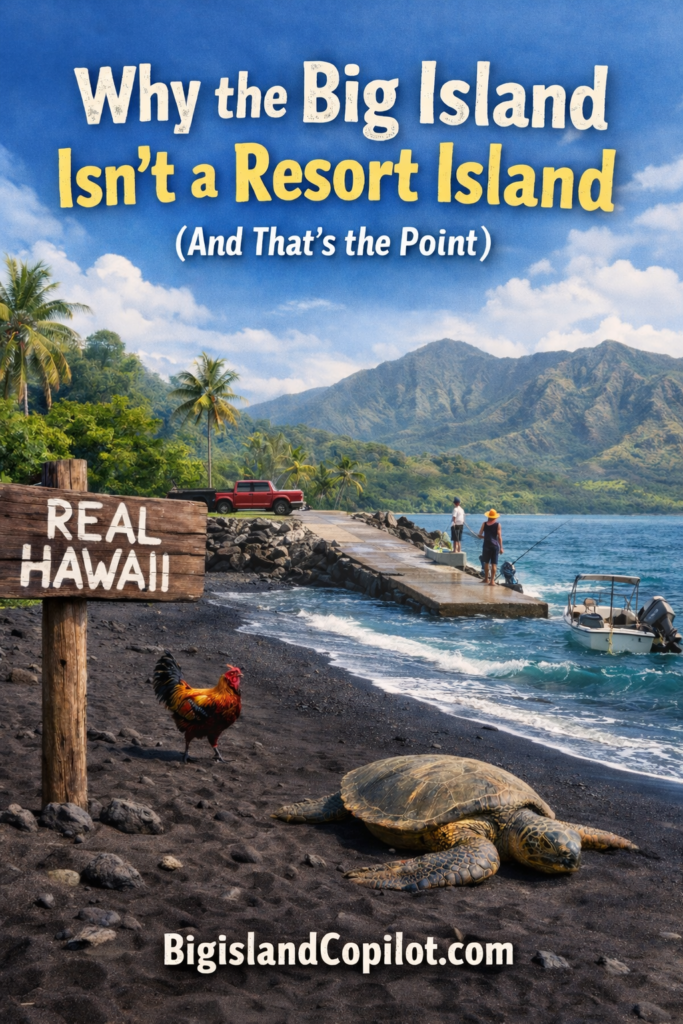
Many visitors arrive on the Big Island expecting the same experience they had on Oʻahu, Maui, or Kauaʻi.
They look for:
A vacation that unfolds effortlessly
Walkable resort towns
Dense clusters of beaches
Short drives between attractions
And then they’re surprised.
Because the Big Island was never meant to be a resort island — and that’s exactly why it leaves such a deep impression on the people who understand it.
This guide explains why Hawaiʻi Island is different, what that means for your trip, and how leaning into that difference creates a far better experience.
1. Scale Changes Everything
The single most misunderstood fact About Hawaiʻi Island is its physical scale.
The Big Island is larger than all the other Hawaiian islands combined, and that size is not abstract — it affects every single decision you make as a visitor.
This isn’t an island you casually bounce around.
It is an island you move through deliberately.
What Scale Actually Means in Practice
Because of its size:
- Two- to three-hour drives are normal
- You can drive for an hour and still be in the same region
- Weather systems don’t pass quickly — they linger
- Emergency services are spread thin by distance
- Fuel stops, food stops, and services are not guaranteed
Distances that look small on a map behave very differently on volcanic terrain.
Why Drive Times Feel Longer Than They Look
A 60-mile drive on the Big Island is not the same as a 60-mile drive on the mainland.
Reasons include:
- Steep elevation changes
- Curving roads around lava fields
- Fog, rain, and wind at higher elevations
- Wildlife and livestock crossings
- Limited lighting outside towns
For example:
- Kona to Hilo: ~2 hours (in good conditions)
- Hilo to Volcano: ~45 minutes
- Kona to Waimea: ~1–1.5 hours depending on route
These are normal, not worst-case scenarios.
Scale Protects the Island
The vastness of the Big Island acts as a natural barrier against overdevelopment.
Large stretches of land are:
- Too young (geologically) to build on
- Too remote to service
- Too culturally important to disturb
- Too environmentally fragile to alter
This is why you’ll find entire coastlines with no hotels, towns with no chain stores, and miles of road with nothing but lava and sky.
That space is intentional.
Scale Forces You to Slow Down
On smaller islands, you can rush.
On the Big Island, rushing backfires.
Trying to “do it all” leads to:
- Exhaustion
- Missed moments
- Dangerous driving
- Shallow experiences
Visitors who embrace the scale:
- Stay longer in fewer places
- Accept weather shifts
- Build buffer days
- Let geography guide the day
They don’t fight distance — they work with it.
The Payoff of Scale
When you stop trying to compress the Big Island, something changes.
You notice:
- Silence between destinations
- Stars without light pollution
- Landscapes that feel untouched
- A sense of perspective that smaller places can’t offer
Scale isn’t an inconvenience here.
It’s the feature that makes everything else possible.
2. Resorts Exist — But They Don’t Define the Island
Yes, there are resorts.
Mostly concentrated along:
- Kona / Kohala Coast
https://maps.google.com/?q=Kohala+Coast
These areas are sunny, dry, and carefully managed.
But step outside those corridors and you’ll find:
- Rainforests
- Lava fields
- Ranch land
- Small towns
- Entire coastlines with no development at all
On the Big Island, resorts are optional, not central.
3. The Land Comes First Here
Much of Hawaiʻi Island is:
- Conservation land
- Agricultural land
- Lava flows too young to build on
- Culturally significant space
Development is constrained not just by law — but by reality.
You don’t bend volcanoes, oceans, or mountains to fit a resort schedule.
The land sets the terms.
4. Beaches Are Earned, Not Packaged
The Big Island has beautiful beaches — but they are:
- Spread far apart
- Often unmarked
- Sometimes difficult to access
There are no endless chains of manicured beach fronts.
Instead, you’ll find:
- Hapuna Beach (large, open, powerful)
https://maps.google.com/?q=Hapuna+Beach - Punaluʻu Black Sand Beach (wildlife-focused)
https://maps.google.com/?q=Punaluu+Black+Sand+Beach - Small pocket beaches locals quietly enjoy
This island rewards effort and awareness, not convenience.
5. Nightlife Isn’t the Point — Nature Is
There is no major nightlife scene.
What replaces it:
- Stargazing
- Listening to rain on a tin roof
- Ocean sounds after dark
- Quiet towns that shut down early
The Big Island doesn’t entertain you.
It gives you room to notice.
6. Infrastructure Is Intentionally Light
Visitors often ask:
“Why isn’t there more here?”
Because more would cost:
- Fresh water
- Cultural integrity
- Ecosystem stability
- Local quality of life
Limited infrastructure keeps this island from becoming something else entirely.
7. This Island Is Built for Curiosity, Not Consumption
You don’t come here to check boxes.
You come here to:
- Learn how volcanoes work
- Understand microclimates
- Experience living culture
- See land still in the process of forming
The Big Island doesn’t sell itself aggressively — and that’s intentional.
8. Why Some Visitors Are Disappointed
The visitors who struggle most are those who:
- Expect everything to be close
- Want constant entertainment
- Don’t like driving
- Want predictable outcomes
This isn’t a failure of the island.
It’s a mismatch of expectations.
9. Why Others Fall in Love Forever
The people who fall hardest for the Big Island are those who:
- Like space
- Respect quiet
- Enjoy learning
- Accept uncertainty
- Don’t need everything curated
They don’t ask the island to change.
They change how they move through it.
10. How to Visit the Big Island the Right Way
- Stay in fewer places, longer
- Build buffer days
- Rent a vehicle you’re comfortable driving
- Let weather redirect you
- Don’t rush sacred or remote spaces
The Big Island reveals itself slowly.
The Real Point
The Big Island isn’t unfinished.
It’s unfinished on purpose.
It is a place where the Earth is still being built, culture is still alive, and silence still exists.
If you wanted a resort island, there are many options.
If you want something rarer —
This is the island that gives it to you.
⚠️ Quick Safety Reminder
Conditions can change suddenly. Always check local conditions, warnings, and official guidance before entering the ocean, lava areas, or trails. Safety is your responsibility.
Aloha, did you like this page?