
⚠️ Big Island Safety Notice
The Big Island’s environment can change rapidly — ocean conditions, lava flows, weather, and trails may become dangerous without warning. These Guides are for educational purposes only and do not replace real-time assessments, posted warnings, or professional guidance. Always check current conditions before entering the water, hiking, or exploring, and do not proceed if conditions appear unsafe — even if a location is described as “safer.”
Table of Contents
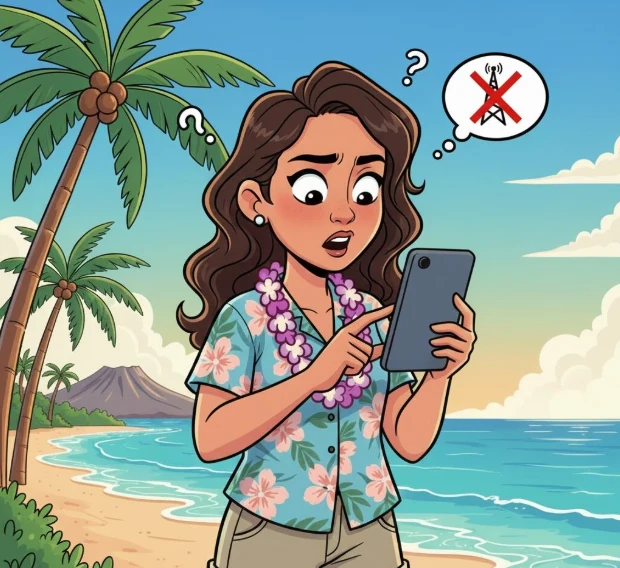
If you’ve ever watched your phone jump from full bars to “No Service” in minutes on the Big Island, you’re not alone. Many visitors are surprised by how quickly cell service disappears—sometimes just a few turns off a main highway. This isn’t a glitch. It’s a combination of geography, infrastructure, and land use unique to Hawaiʻi Island.
Understanding why this happens can help you plan safer trips, avoid getting stranded, and make smarter decisions when exploring remote areas.
1. The Big Island’s Size Works Against Cell Coverage
The Big Island is larger than all the other Hawaiian islands combined. With vast distances between towns and population centers, it’s impractical to build dense cell tower coverage everywhere.
Unlike mainland areas where towers can be placed every few miles, much of the Big Island is undeveloped lava fields, forests, ranch land, and conservation zones, where towers don’t exist.
Learn more About island geography here:
https://www.hawaiitourismauthority.org/
2. Mountains Block Cell Service on the Big Island—Completely
Mauna Kea and Mauna Loa aren’t just mountains—they’re massive signal blockers. Even smaller ridges and cinder cones can cut off reception instantly.
Cell signals rely on line-of-sight. When a mountain, ridge, or even a steep lava berm gets between you and the nearest tower, service can drop to zero without warning.
This is why service may work perfectly on one side of a hill and vanish immediately on the other.
More on radio signal behavior:
https://www.fcc.gov/general/cell-phone-service-and-coverage
3. Lava Terrain Absorbs and Scatters Signals
The Big Island’s volcanic landscape isn’t friendly to radio waves. Hardened lava flows, ʻaʻā fields, and rough basalt surfaces absorb and scatter signals, reducing their range and reliability.
This is especially noticeable in areas like:
- Puna
- Kaʻū
- South Kona
- Saddle Road side routes
GPS might still show roads, but your phone may already be offline.
4. Towers Are Placed for People, Not Roads
Cell towers are built to serve population centers, not scenic routes. That means highways connecting small towns may have long gaps with no coverage at all.
If a road doesn’t serve a town, school, hospital, or business district, it’s often low priority for infrastructure investment.
Coverage maps can be misleading because they assume ideal conditions.
Check carrier coverage maps here:
- https://www.verizon.com/coverage-map/
- https://www.att.com/maps/wireless-coverage.html
- https://www.t-mobile.com/coverage/coverage-map
5. Conservation and Cultural Lands Limit Infrastructure
Large parts of the Big Island are protected:
- Conservation districts
- Cultural and ancestral lands
- State and national parks
Installing cell towers in these areas to improve cell service on the Big Island requires extensive approval, and in many cases, it simply isn’t allowed.
For example, Hawaiʻi Volcanoes National Park has very limited service by design:
https://www.nps.gov/havo/planyourvisit/cellphones.htm
6. Weather Can Instantly Kill Signal
Heavy rain, dense fog, and volcanic haze (vog) can all degrade cell signals. On the Big Island, weather conditions can change rapidly, especially at elevation.
Even if you had service earlier in the day, it may vanish after:
- Sudden rainstorms
- Driving into cloud cover
- Evening temperature shifts
Weather updates:
https://www.weather.gov/hfo/
7. Rural Roads Often Have Zero Redundancy
On the mainland, your phone may switch between towers seamlessly. On the Big Island, many areas are covered by a single tower—or none at all.
If that tower is blocked by terrain or temporarily offline, there’s no fallback.
This is why service can disappear “all at once” instead of slowly degrading.
8. GPS Still Works—But Everything Else May Not
Your phone’s GPS chip works independently of cell service, which is why maps may still show your location. However:
- Turn-by-turn directions may stop
- Search won’t work
- Calls and texts will fail
- Emergency info may not load
Offline maps are critical:
https://support.google.com/maps/answer/6291838
9. Emergency Response Can Be Delayed Without Service
In remote areas, no cell service on the Big Island means:
- No 911 calls
- No roadside assistance
- No live location sharing
Response times can be long, especially in Kaʻū, South Kona, and rural Hāmākua.
Hawaiʻi County emergency resources:
https://www.hawaiicounty.gov/departments
10. Locals Plan for No Signal—Visitors Often Don’t
Local residents expect service gaps and prepare accordingly. Visitors often assume coverage will return “any second” and continue driving deeper into remote areas.
That assumption leads to:
- Running out of gas
- Getting stuck on bad roads
- Being unable to call for help
Local knowledge matters more than technology here.
11. Night Makes Cell Service on the Big Island Worse
After dark, limited visibility combined with no cell service increases risk. Missed turns, wildlife on roads, and unmarked hazards become harder to manage without navigation or communication.
This is one reason locals avoid unnecessary night driving in rural areas.
12. Why “Just Follow GPS” Can Be Dangerous
Without cell service, GPS apps can’t warn you about:
- Road closures
- Flooded crossings
- Private roads
- Unsafe terrain
What looks like a shortcut on your phone can turn into a dead end—or worse.
What You Should Always Do Before Entering Remote Areas
- Download offline maps
- Tell someone where you’re going
- Carry water and snacks
- Keep your fuel tank above half
- Don’t rely on cell service returning
Bottom Line
On the Big Island, disappearing cell service isn’t a bug, it’s not your provider—it’s reality. The island’s size, terrain, culture, and land protections make coverage gaps unavoidable.
Smart travelers plan for no signal, not perfect reception.
That’s how you stay safe—and enjoy the island without surprises.
⚠️ Quick Safety Reminder
Conditions can change suddenly. Always check local conditions, warnings, and official guidance before entering the ocean, lava areas, or trails. Safety is your responsibility.
Aloha, did you like this page?